Segment Routing (MPLS) Configuration Module
This configuration module configures Segment Routing with MPLS encapsulation (SR-MPLS) and Node SIDs within the IS-IS or OSPFv2 routing process.
Supported Features
Supported Segment Routing features (see also Supported Platforms):
IPv4 and IPv6
IS-IS and OSPFv2 routing protocols
IPv4 Node SID
IPv6 Node SID (IS-IS only)
The module depends on the IS-IS or OSPF configuration module and will report an error if the required IGP configuration module is not enabled.
Supported Platforms
SR-MPLS is implemented on the following platforms:
Operating system |
IPv4 |
IPv6 |
IS-IS |
OSPFv2 |
|---|---|---|---|---|
Arista EOS |
✅ |
✅ |
✅ |
✅ |
Cisco IOS XE[1] |
✅ |
❌ |
✅ |
✅ |
Cisco IOS XR[2] |
✅ |
✅ |
✅ |
✅ |
FRRouting |
✅ |
✅ |
✅ |
✅ |
Junos[3] |
✅ |
✅ |
✅ |
❌ |
Nokia SR Linux ❗ |
✅ |
❌ |
✅ |
❌ |
Nokia SR OS[4] |
✅ |
✅ |
✅ |
❌ |
Global Parameters
You can use IS-IS or OSPFv2 as the IGP with SR-MPLS. Specify the lab-wide SR-MPLS protocol(s) with the sr.protocol global parameter. The default value is isis, valid values are isis and ospfv2. You can also specify a list of IGP protocols to support more complex scenarios[5].
The SR-MPLS module configures Node SIDs for the IPv4 and IPv6 address families (AFs). The values of the AF Node SID are generated from node identifiers and AF-specific offsets. These offsets are controlled with two global parameters:
sr.node_sid_offset.ipv4 (default: 0) – Node SID offset for IPv4 loopback prefix
sr.node_sid_offset.ipv6 (default: 100) – Node SID offset for IPv6 loopback prefix
You can also control which address families participate in SR-MPLS with the global sr.af dictionary. If sr.af is not defined, SR-MPLS is enabled for all address families configured on the node.
sr.af.ipv4 (boolean) – Enable or disable SR-MPLS for IPv4
sr.af.ipv6 (boolean) – Enable or disable SR-MPLS for IPv6
Device Parameters
Some devices (Nokia SR OS, Nokia SR Linux) have a configurable Segment Routing Global Block (SRGB). The SRGB can be configured with these device- or node attributes:
sr.srgb.start – the start of SRGB
sr.srgb.size – the size of SRGB
You can set these parameters as node attributes or change device defaults, for example:
defaults.devices.srsim.sr.srgb.start: 200000
Node Parameters
The SR-MPLS-enabled nodes inherit the sr.protocol settings from the lab topology. You can overwrite that setting with the node sr.protocol attribute.
You can configure Node SIDs (mapped to loopback IPv4/IPv6 prefixes) with these node parameters:
sr.node_sid.ipv4 (default: node identifier) – IPv4 Node SID
sr.node_sid.ipv6 (default: node identifier + 100) – IPv6 Node SID
You can limit the SR-MPLS address families for an individual node with the sr.af node dictionary (details). Use this parameter in dual-stack labs with devices that do not support SR-MPLS for IPv6 or when running SR-MPLS with OSPFv2. Without an explicit sr.af definition, SR-MPLS is configured for all address families[6] used by the node.
Example
We want to create a four-router multi-vendor SR-MPLS network.
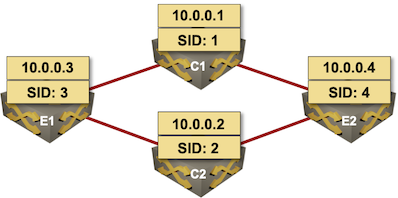
All devices run IS-IS and SR-MPLS:
module: [ sr, isis ]
We want to use unnumbered P2P interfaces and dual-stack deployment with IPv6 configured on loopback addresses:
addressing:
  p2p:
    unnumbered: true
  loopback:
    ipv6: 2001:db8:cafe::/48
Two of the devices in our topology run Cisco IOS XE, and the other two run Arista EOS:
nodes:
  e1:
    device: csr
  e2:
    device: eos
  c1:
    device: csr
  c2:
    device: eos
The devices are connected into a square topology, with two of them having stub links:
links:
- e1-c1
- e1-c2
- e2-c1
- e2-c2
- e1
- e2
Resulting Device Configurations
The above topology generates the following device configurations (focusing just on segment routing and IS-IS parts).
E1 (Cisco IOS)
segment-routing mpls
 !
 set-attributes
  address-family ipv4
   explicit-null
  exit-address-family
 !
 !
 connected-prefix-sid-map
  address-family ipv4
   10.0.0.3/32 index 3 range 1
  exit-address-family
!
interface Loopback0
 ip address 10.0.0.3 255.255.255.255
 ip router isis Gandalf
 ipv6 address 2001:DB8:CAFE:3::1/64
 ipv6 router isis Gandalf
!
router isis Gandalf
 net 49.0001.0000.0000.0003.00
 is-type level-2-only
 metric-style wide
 log-adjacency-changes
 segment-routing mpls
 !
 address-family ipv6
  multi-topology
 exit-address-family
E2 (Arista EOS)
interface Loopback0
   ip address 10.0.0.4/32
   ipv6 address 2001:db8:cafe:4::1/64
   node-segment ipv4 index 4
   node-segment ipv6 index 104
   isis enable Gandalf
!
router isis Gandalf
   net 49.0001.0000.0000.0004.00
   is-hostname e2
   is-type level-2
   log-adjacency-changes
   !
   address-family ipv4 unicast
   !
   address-family ipv6 unicast
      multi-topology
   !
   segment-routing mpls
      no shutdown